
Lincoln County Court Records After Arrest
An arrest in Lincoln County starts on the law-enforcement side. A person may be taken to the Lincoln County Jail for booking, identity checks, warrant review, screening, and bond or hold information. The court-record side begins when the Lincoln County Attorney reviews the facts and files, amends, dismisses, or negotiates charges. The county attorney's official page says the office is primarily a criminal prosecution agency representing citizens and crime victims in felony, misdemeanor, traffic, juvenile, care-and-treatment, asset-forfeiture, and post-conviction matters.
Jail booking records and court records after a jail arrest answer different questions. Jail records answer whether a person is in custody, booked, released, transferred, or held. Court records answer whether a complaint, information, citation, warrant, hearing, plea, sentence, dismissal, or disposition exists. For custody and booking details, use Lincoln County jail inmate records. For booking photos and release limits, use Lincoln County jail mugshots.
Find Lincoln County Court Records
Lincoln County District Court is part of the Kansas trial court system. The local court page says records related to most judicial proceedings are available at the District Court Clerk's office or may be available online through a subscription service. Kansas Case Search provides public district court case information by case number, party name, business name, citation, or attorney. Older records, sealed records, unavailable records, and details that do not appear online may require clerk help.
- Open Kansas Case Search for public district court case information.
- Search by defendant name, case number, citation, business name, or attorney if one is known.
- Open the matching case and read the charge list, case events, hearings, bond entries, warrants, and disposition fields.
- Compare filed court charges with any jail booking charges because the prosecutor may amend, reduce, add, or dismiss counts.
- Contact the Lincoln County District Court clerk for older, sealed, terminal-only, subscription, or unclear records.
The Kansas Case Search entry page is the statewide online starting point for Lincoln County court records after arrest.
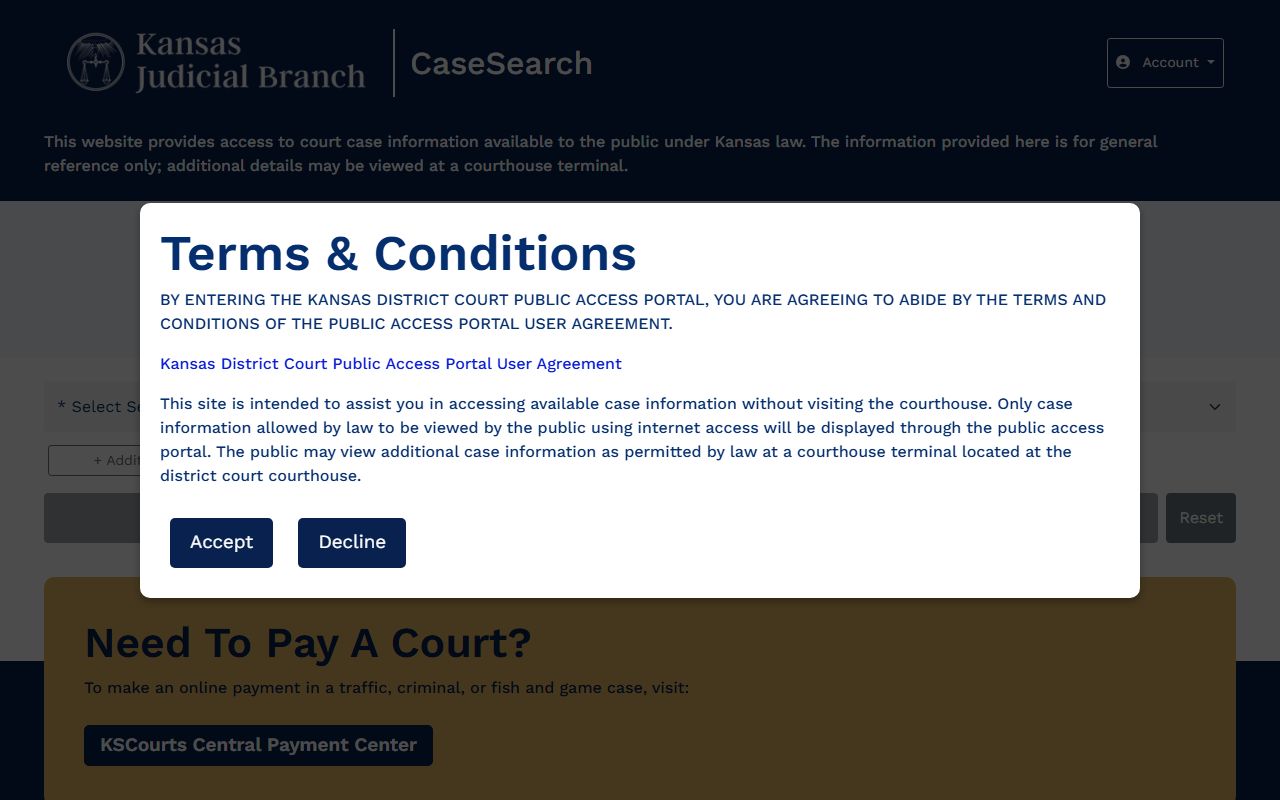
Case Search should be paired with local clerk contact when a record is sealed, too old for the online index, or not yet updated after a recent arrest.
Lincoln County Court Search Fields
The research captured the main Kansas Case Search paths. A case number is best when it is known, but name and citation searches are often more realistic after a new Lincoln County jail arrest. Search fields are not proof of guilt. They are entry points for finding public court records.
| Field Label | Type | Required | Notes |
|---|---|---|---|
| Case number | Text | Optional | Best if the citation or district court case number is known. |
| Party name | Text | Optional | Common defendant-name path for criminal cases. |
| Business name | Text | Optional | Less common for inmate-related searches. |
| Citation | Text | Optional | Useful for traffic and citation-based criminal matters. |
| Attorney | Text | Optional | Can locate cases tied to a known attorney. |
| Advanced filters | Varies | Optional | Kansas Judicial Branch announcements describe enhanced filters. |
Charges Filed After a Lincoln County Arrest
The Lincoln County Attorney, Scott Wright, has discretion to decide whether to charge, what charges to bring, whether to dismiss, and whether to negotiate a plea. That discretion is why the court records after a jail arrest may not match the first booking language. A jail booking charge is an arrest or holding allegation. A court charge is the formal charge filed and tracked in the court case.
| Document | Who Uses It | What It Does |
|---|---|---|
| Complaint | Prosecutor or officer path | Starts many criminal cases with the charge allegations used for the first court stage. |
| Information | Prosecutor | Formal charging document commonly used after preliminary proceedings in felony matters. |
| Indictment | Grand jury | Grand-jury charging document, less common in routine local cases. |
Lincoln County Charge Status
Charges can change as a Lincoln County case moves through district court. A count may be pending at first appearance, amended after review, reduced through negotiation, dismissed by the prosecutor, or resolved by plea, trial, diversion, or another court order. Always read the latest docket entry and disposition, not just the first charge line.
| Status | What It Means |
|---|---|
| Pending | The case or charge remains open and has not reached final disposition. |
| Amended | The charge language, count, or level changed after filing. |
| Reduced | A charge was lowered as part of review, plea negotiation, or court action. |
| Dismissed | The court record shows the charge was dropped or ended without conviction on that count. |
| Disposition entered | The court recorded a final outcome, such as plea, conviction, diversion, acquittal, or dismissal. |
Bond After a Lincoln County Arrest
Kansas bond authority comes from K.S.A. 22-2802. At first appearance, a magistrate may set an appearance bond in an amount sufficient to assure appearance and public safety. The court can also impose release conditions. A person may still remain in custody if a warrant, detainer, parole or probation hold, no-bond order, or another agency hold blocks release.
| Bond Type | How It Works |
|---|---|
| Cash bond | Money is paid directly as security under the court's order. |
| Surety bond | A licensed bondsman posts bond under Kansas commercial bail practice. |
| Personal recognizance | The person promises to appear without posting the full cash amount, if the court orders it. |
| No-bond hold | Custody continues because bond is unavailable or another hold prevents release. |
Lincoln County Court Contacts
Lincoln County District Court is located at 216 E Lincoln Ave in Lincoln. The local court page names Hon. Jennifer O'Hare as judge and Lisa Feldkamp as clerk, with phone 785-524-4057, fax 785-524-3204, and email lisaf@12jd.org. The Lincoln County Attorney's Office is also at 216 E Lincoln Ave and lists Scott Wright, phone 785-524-4380, fax 785-524-4302, and office hours of 8:00 a.m. to 4:30 p.m. CST.
The Lincoln County District Court page is the local source for court contact and records-access notes.
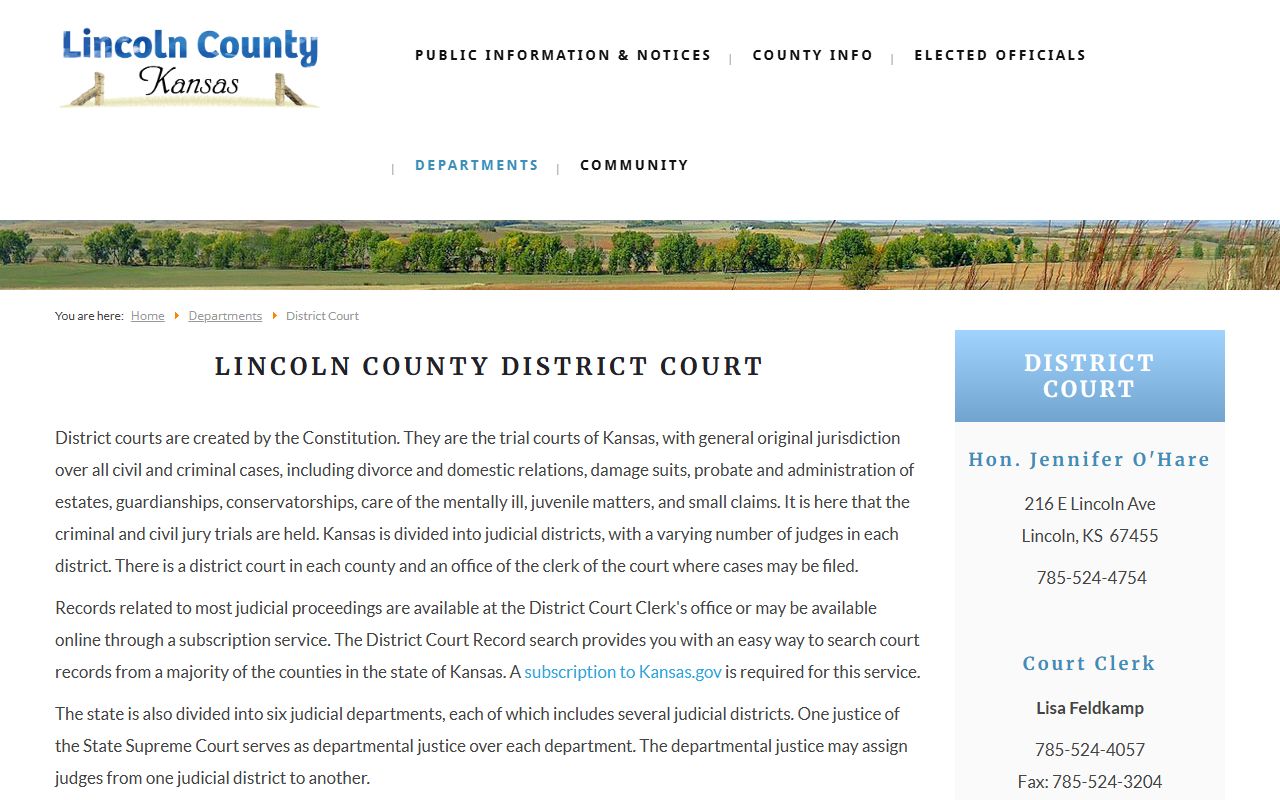
Use the clerk when online search does not resolve a case, when a record may be sealed, or when a courthouse terminal or subscription service is needed.
Warrants and Lincoln County Arrest Records
No official Lincoln County sheriff active-warrant search or most-wanted list was located on the Kansas county pages. A warrant can still lead to a jail booking, including arrest warrants, bench warrants for failure to appear, probation or bond violation warrants, search-related custody events, fugitive warrants, or holds from another jurisdiction. Check the sheriff for custody information that can be released, the district court for case-linked bench warrants, and Kansas Case Search for public docket events.
Important: Warrant affidavits and sworn testimony may follow a separate access process and are not ordinary KORA records.
Charges, Convictions, Sealed Records
Court records after a Lincoln County arrest should not be read as proof of conviction unless the disposition says so. A charge is an accusation filed in court. A conviction is a final result after plea, trial, or other qualifying disposition. Kansas also allows expungement petitions for some arrest records, convictions, and diversions under statutes such as K.S.A. 22-2410 and K.S.A. 21-6614.
| Charge | Conviction | |
|---|---|---|
| Stage | Filed accusation after arrest or citation | Final court result after plea, trial, or judgment |
| Meaning | Not proof that the person committed the offense | Court finding or plea accepted as the case outcome |
| Record Review | Check amendments, dismissals, and disposition | Check sentence, probation, appeal, or expungement status |
Sealed and expunged records also differ. A sealed record is hidden from public access under a court order or statute. Expungement limits access to eligible records and changes how the record may be treated in many public contexts, but law-enforcement or court access may still exist in defined circumstances.
| Sealed | Expunged | |
|---|---|---|
| Public view | Not open in ordinary public search | Public access is limited after a qualifying order |
| How it happens | By court order, statute, or case type | By petition and statutory eligibility |
| What to verify | Ask the clerk about public access limits | Review the expungement order and remaining exceptions |